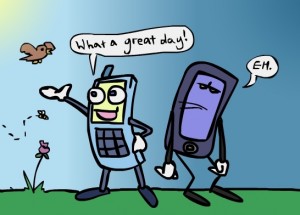
One dumbphone advocate, Nicholas Carr, who is quoted in the March 23 New York Times article “A Smartphone Future? But Not Yet” by Teddy Wayne, argues, “Because of the brain’s neuroplasticity, Web surfing rewires people to be more adept at perfunctory multitasking, but diminishes the ability to sustain focus and think interpretatively. We stop having opportunities to be alone with our thoughts.” By using a smartphone, one perfects multitasking skills at the expense of our critical, introspective thinking. The ability to interpret the world for ourselves is what defines us as humans, and the theory that smartphones take away an individual’s skills to think for ourselves implies that our culture has backfired on us. We have sacrificed our analytical skills for the lure of new technology.
The effect of the smartphone on human interaction is deeper than one might think. In Matt Richtel’s Aug. 4, 2010 New York Times article, “Digital Devices Deprive Brain of Needed Downtime,” a professor of physiology at UC San Francisco, Loren Frank, explains, “Almost certainly, downtime lets the brain go over experiences it’s had, solidify them and turn them into permanent, long-term memories. … When the brain is constantly stimulated, you prevent this learning process.” This solidification of long-term memory is impaired when people become overly dependent on smartphones for entertainment. When waiting at a bus stop, in line at the grocery store or even during a lull in a conversation, people pull out their phones to keep themselves stimulated. However our personal demands to be kept busy and entertained by using our phones are depriving us of our cognizance of the world around us.
The smartphone user’s demand for connection is fatiguing him or her by overloading the brain with endless data. This is precisely why the dumbphone movement exists – people see that the smartphone devalues face-to-face connection and puts a person at risk for losing their ability to simply think.
There are instances when I am grateful for the iPhone’s many services, such as the GPS or being able to access the Internet to look up a recipe. But the possibility that being accustomed to a smartphone could change something within my personality, as well as decrease my awareness of life, just doesn’t seem worth the ownership of the smartphone.
The dumphone users have taken one step further in the direction of correcting the thoughtless nature of our culture by rejecting phones that promote endless multitasking at the cost of critical thinking. If you would sooner streak naked across campus during Convo than trade in your iPhone for a dumbphone (let’s face it, most of us would), at least allot some time to switch your phone off. With less focus spent on technology, who knows what we might learn about the world around us?
This is the opinion of Anna-Michelle Escher, a junior communication studies major from Stanford, Calif. Please send comments to aescher@theloyolan.com.
Source: The rise of the dumbphone movement

Yeah! Long life to dumbphones!